
Solution Brief
One Platform, Every Fuel: The Case for Unified Fuel Distribution Software
The industry runs on thin margins and split-second decisions. When the back office and the trucks operate on separate systems, every delay costs a distributor money.
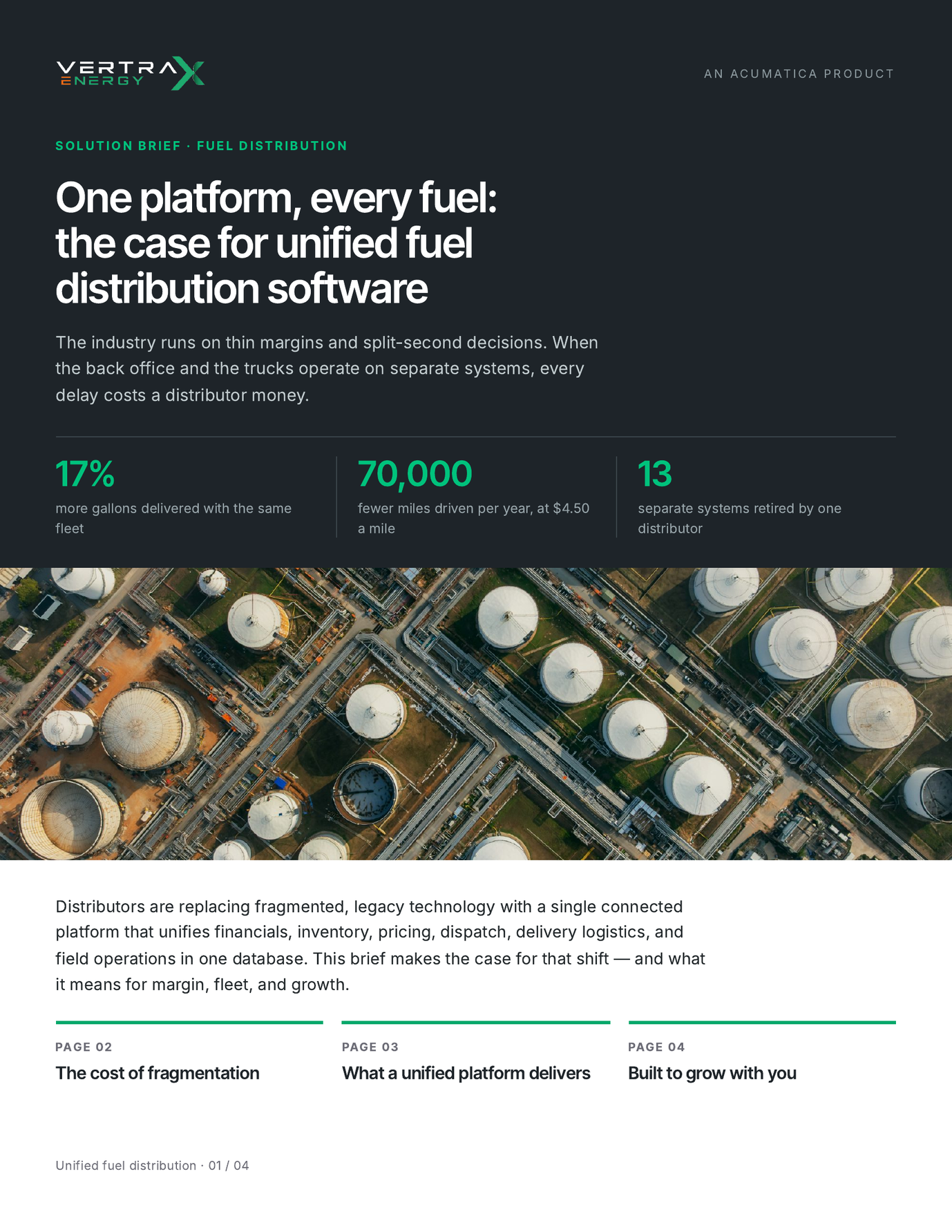
Distributors are replacing fragmented, legacy technology with a single connected platform that unifies financials, inventory, pricing, dispatch, delivery logistics, and field operations in one database. This brief makes the case for that shift, and what it means for margin, fleet, and growth.
The cost of fragmentation
Most distributors never planned to run ten or more separate systems. It happened gradually: a dispatch tool added here, a pricing bolt-on there, a spreadsheet to bridge the gap. Over time, the patchwork becomes the operation.
The cost is real and measurable. When back-office software and dispatch do not share a database, drivers' paperwork piles up until someone keys it in at the end of the day. Afternoon deliveries ship at morning rack costs. Invoicing slips to the end of the week instead of the day the product moves.
Legacy platforms compound the problem. Many distributors still run DOS-era or sunsetting systems their vendors have scheduled for end-of-life, carrying server maintenance, security exposure, and disruptive upgrade cycles. Those platforms were built for a single product line, so hybrid operators end up running one system for midstream wholesale and another for downstream retail, because no single legacy tool can hold both.
Where the money leaks
Mispriced deliveries, unbilled surcharges, and unlanded costs surface in a month-end post-mortem, long after the gallons moved.
No single system holds tank levels, consumption history, and forecast demand at once, so dispatch reacts instead of planning.
Meter reads, gallons, and bills of lading are keyed a second time in the office, and reconciliation becomes a job of its own.
When something breaks between systems, vendors point at each other while the operation waits for an answer.
The question is not whether fragmentation is costing you. It is how much.
What a unified platform delivers
One database connecting the office and the truck, from refinery to residence.
When rack prices move mid-morning, revised pricing reaches drivers' devices before the afternoon's deliveries roll. Freight and fuel surcharges calculate themselves, and landed cost is visible the moment a delivery is confirmed.
Meter readings, actual gallons, bill-of-lading data, and signatures captured in the field write back to the order. The same transaction updates inventory, triggers the invoice, and posts to the ledger.
Degree-day forecasting (consumption history, K factors, burn rates, and postal-code weather) generates the next delivery before a tank runs low, and telemetry turns a threshold crossing into an order.
When the back office and the truck share one data model, close compresses from weeks to days. Controllers reconcile against orders, not spreadsheets, and audit-ready financials become a byproduct of daily work.
Priced at 8am. Delivered at 2pm.
- 8:00amDay's price set from the imported rack cost
- 11:00amThe rack jumps mid-morning
- 11:05amNew price pushed to the field, notices sent
- 2:00pmDelivered, and billed at the new rate
On a disconnected system the afternoon ships at the morning's cost. That margin is simply gone.
Capabilities a unified platform should include
- Live rack feeds with intraday repricing to the field
- Driver mobility: meter reads, gallons, proof of delivery
- Embedded financials: GL, AP, AR, and cash management
- Multi-entity, multi-location on one connected system
- Native dispatch with HazMat and load optimization
- Tank telemetry and degree-day demand forecasting
- Every delivery model, from will-call to bulk transport
- Open APIs for telematics, payments, and tax compliance
Built to grow with you
Growth in fuel distribution rarely follows a straight line. Acquisitions bring branches, market shifts require new product lines, and customers move from residential heating oil to fleet fueling to propane.
A platform that cannot absorb that complexity forces another bolt-on, and the cycle starts again. On a unified system a new branch joins the same database, and a new fuel or delivery model is a configuration, not an integration project.
Cloud-native architecture removes the infrastructure burden: no local servers, no upgrade weekends, no unpatched exposure. A controller at home and a dispatcher in the field see the same data at the same moment.
The right platform is not the one that handles what you do today. It is the one that handles what you need to do next.
A phased path to one platform
Consolidation is a sequence, not a switch. Distributors who do it well retire systems in an order that protects the operating day.
-
Map the estate, and what each system costs
Count the tools, licenses, servers, and the hours spent moving data between them. Bolt-ons rarely look expensive until they are listed together.
-
Close the price-to-delivery loop first
Cost in, price out, delivery confirmed, invoice issued. Fixing that loop returns margin in the first season and funds the rest of the work.
-
Move finance and dispatch onto one record
Phase the cutover so deliveries keep running, and bring history across so the first close is a reconciliation, not an investigation.
-
Then treat growth as configuration
New branches, fuels, and delivery models join the same database, and each one proves the platform rather than testing it.
Evaluate your own platform against these questions
- Can it push intraday price changes to drivers before afternoon deliveries?
- Does a delivery confirmation update inventory, invoice, and the ledger?
- Can you add a branch or fuel type without a multi-month integration?
- Do dispatch and finance work from the same data, in real time?
If the answer to any of these is no, the cost of the current system is greater than its line item on the budget.
About Vertrax
Unified cloud ERP and delivery logistics for midstream and downstream fuel distributors. Founded on Acumatica's platform, Vertrax was acquired in 2026 by Acumatica, a recognized ERP market leader delivering innovative, AI-enabled business management solutions to more than 10,000 businesses worldwide with the industry's highest customer satisfaction scores.
See it on your own terms.
Schedule a demo to see how Vertrax Energy closes the price-to-delivery loop, or estimate what consolidating your systems is worth.